Knee: stage 1: six weeks non-weight-bearing
The backstory…
… is spread across various blogs (Viadal 6 day: pre-race and LAU: pre-adventure & the next big thing? rehab), but here’s a short summary. After several months of niggles in my right leg, my knee gave way while running on a treadmill. For several days I couldn’t bear weight on a bent leg. It initially seemed to get better fairly quickly, but running, or indeed anything other than moving forwards slowly in a straight line on a level surface, made it angry. Nearly a year after the initial injury (having managed to finish the Lapland Arctic Ultra in the meantime), I finally got a diagnosis: a radial meniscus tear extending into the medial posterior root. Initially, I was under the impression it wasn’t repairable (and I’d need a knee replacement in the near future); however, it turned out that it was.
Week -1
The 10-day gap between being told that a repair was possible and it actually happening was perfect. Just enough time to get everything organised, both at work and at home, without rushing. We bought various useful things (more about them at the end of this blog), and generally figured out how day-to-day life was going to work with one functional leg. This including practising using crutches. I initially wasn't sure about getting up the two steps into our house. However the OH, who spent a few weeks on crutches as a teenager, demonstrated how to do it, and 'if he can do it, so can I' was sufficient motivation. I had to go to the hospital for MRSA swabs, and was issued with 'decontamination wash' to use daily, which my hair really didn't like.

decontaminated!
D-Day
After admission at 11 am, there was then lots of talking to different people (surgeon, anaesthetist, physio, doctor dispensing medicine, nurse administering a pregnancy test…) and waiting around before the operation finally took place mid-afternoon. I opted to have a general anaesthetic, mainly because I hadn’t realised that being conscious was an option and hadn’t got my head around that possibility in advance. I came round quite quickly and somehow ended up having a conversation with the anaesthetist about Brian Cox (I once ate breakfast at the same table as him at a conference).
There were then several more hours of waiting before I was deemed sufficiently recovered and mobile to go home, with a large bag of medication (paracetamol, codeine, morphine, blood thinners and two different laxatives…). I was wheeled out to the OH’s car and bum-shuffled my way onto the back seat. Thanks to practising in advance, I happily hopped my way up the steps into the house, and then stopped concentrating and nearly kicked one of my crutches out from under me. The OH was tired after a long day, but I was apparently ‘high as a kite’ and insisted on sitting in a chair and eating mashed potato before going to bed.
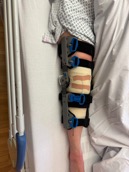
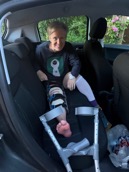
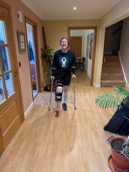
Week 1
I don’t remember much about week 1. At the time I thought I was fairly ‘with it’, but in retrospect I wasn’t. Fortunately, the OH was able to work from home, so he was able to bring me food and medication. All I had to do was crutch my way between the bedroom, the sofa, and the toilet, and pass the time doing my exercises, watching television, surfing the web, reading, sewing and napping. With the Tour de France coming up, we took out an HBO Max/TNT subscription, so I had plenty of random sports to watch. Fortunately, various blogs forewarned me that post-surgery life on crutches would take a lot of energy, and the downtime wouldn’t be the opportunity for indulging in sedentary hobbies that you might naively think.
The hospital physio had given me a leaflet of exercises and told me to aim for 90 degrees of heel-slide flexion by the 2-week follow-up appointment. True to girly swot form, I had my first go at the exercises before getting out of bed (but post-espresso…) on day 1. The instructions said to use your hands to gently move your leg to start with, so I did, and it bent to 90 degrees easily. I then did it without hands. 90 degrees again easily. The other exercises, including straight leg raises, went similarly smoothly.
Initially, I followed the discharge instructions to take paracetamol and codeine at regular intervals, but after a few days I tapered off first the codeine and then the paracetamol, since I wasn’t actually in any pain most of the time. The one exception was at night. I’m a restless (violent even…) sleeper, so sleeping on my back with my leg in a brace was a challenge. I’d often fall asleep fairly easily, but then get woken up by sharp electric shock-like pains (which morphine didn’t help with) after trying to roll onto my side. It would then take several hours to get back to sleep again.
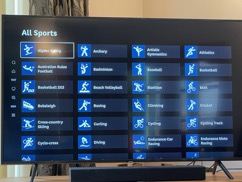
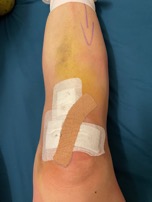
All the sport…, and knee unwrapped.
Week 2
Having spent all of week 1 wearing the same clothes for 24 hours, I returned to civilisation and started wearing ‘night’ and ‘day’ clothes, including a bra during the day. The bra turned out to be very useful for carrying small items, e.g. espresso cups, packets of crisps, toothbrushes. Running shorts were also practical for going to the loo; short baggy ones with built-in pants for days at home, and longer 2-in-1 shorts on rare days out, to avoid inflicting my thighs on other people. On the subject of thighs, the shorts made me painfully aware of the increasing size of my thighs and stomach. I tried to strike a balance between avoiding excessive comfort eating while acknowledging that some weight gain would be inevitable, sensible even, since resticting calories would not be conducive to recovery (or happiness).
Showering was a twice a week military operation. First I'd have to undress, which involved taking the brace off and then putting it back on, before we wrestled a waterproof full-leg cast cover (it became known as 'the leg condom') onto my leg. Then I'd hop my way through to the bathroom, sit on a chair, bum-shuffle along the edge of the bath and finally transfer myself onto a rotating shower stool. After showering with the OH's help, this process then had to be reversed.
We set up a toasting station on the kitchen table so that I could make myself breakfast and lunch. Not just on days when the OH had to go into the office, but so that I could feel a bit more independent in general. A small zip-up OMM backpack (often worn on my front like a backpacker) proved useful for carrying around items that were too large to fit down my bra. Every trip off the sofa required forethought, like arriving at a checkpoint in a multiday race (‘What do I need to do?’ ‘What’s the best order to do it in?’). By the middle of the week, I was sufficiently bored and alert to unofficially do some very light work (reading some of my very large ‘papers to read’ backlog).
We went on our first lunch trip outing and nearly bit off more than we could (metaphorically) chew. We decided to go to a cafe in a park with a car park. Unfortunately, the short walk from the car park (which I’ve run on many occasions) was close to a quarter of a mile, which is a long way to essentially hop. And one of the two benches on the way was (it turned out when I tried to sit on it) broken. With lots of standing rest breaks, we made it to and from the cafe without mishap, but the food was crap (a supermarket bread roll filled with nothing but cheap cheese, followed by ice cream with ice in). But I was left with a sore shoulder for several days, and if I hadn’t had to devote all of my energy to hopping, I might have used my crutches to attack the bloke who told the OH that he’d deserve a break after looking me…
The week ended with a trip to the hospital to get the stitches removed and see the physio. Apparently my knee mobility was where it should be 6 weeks post-surgery, and when we told the physio that Nigel knee had been bending to 90 degrees since day 1, he declared it ‘unprecedented’. The surgeon should get the credit for that, but I’ll take the credit for my ‘excellent single-leg balance’. This was all great news, but I’d gone in expecting to be given new exercises and to have the range of motion of the brace increased, so I was a bit disappointed to be told ‘keep doing what you’re doing for the next 4 weeks’.
Naming your injured body part was one of the things that the (somewhat American) book 'Rebound: train your mind to bounce back stronger from sports injuries' recommended. It felt a bit silly, but I think it did help me depersonalise the injury and not get frustrated with the knee. Over the weeks Nigel developed the personality of a sulky teenage boy, who'd rather lie on the sofa than do his exercises.
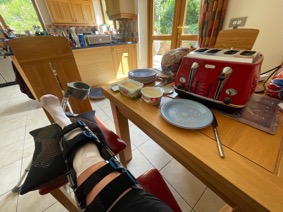
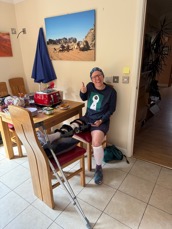
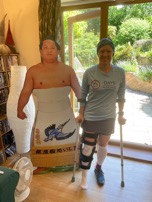
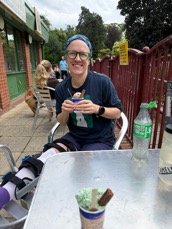
Very happy about being able to make my own toast, and with an early birthday present (a life-size cardboard cut out of one of my favourite sumo wrestlers, Midorifuji). Less happy with crap ice cream.
Week 3
I officially started working part-time, horizontally on the sofa or sitting on the bed (I realised early on that doing meetings lying on the sofa led to a double chin, and the bed was better for sitting upright). The nurse who did my discharge letter put ‘2-6 weeks’, rather than ‘6 weeks’, next to ‘return to work’ after I told her it would just be meetings and emails and promised to take it easy. It took me all of the first day to catch up on emails, which left me surprisingly tired. Later in the week, light upper-body weight lifting two days in a row wiped me out again.
Sleeping became easier, as I was able to sleep lying on either side. And I eventually worked out how to move from one position to another without waking myself up too much.This week included my birthday and another disappointing lunch trip out, to a cafe on the Chesterfield Canal that I’ve run past hundreds (literally) of times. It was advertised as accessible, but there was a steepish slope from the uneven gravel car park, and the elderly clientele weren’t particularly sensitive/alert to the challenges of being on crutches. And the food was only marginally better than last week’s.
Towards the end of the week, I had my first low patch. I think due to putting too much emphasis on being ‘nearly halfway through’, when there was still a long way to go.
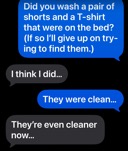
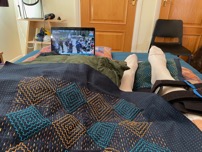
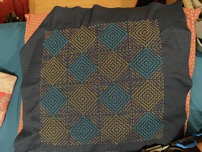
The OH being over-efficient about doing laundry, sewing while watching the Western States live-stream.
Week 4-6
I hadn’t ventured out into the back garden because the doorstep was too wide and high to hop over. However, on a Sunny day when the OH was out at work, I decided to give it a go. I can’t quite do a proper pistol squat. But with something solid to hold onto, it turned out I could do a single-leg squat down, butt-shuffle over the doorstep and then stand back up on the single leg. 30 min outside on my own felt like a big adventure (the lack of independence and ‘possibility’ was the thing I found hardest). At the weeked, when the OH was at home, I ventured out into the garden for longer. The OH came out and moved me as the Sun moved. This was very thoughful, but made me feel like a rather fragile garden gnome. I also butt-shuffled my way upstairs for a little bit of one-legged gong and singing bowl playing. [I was very lucky that we have a downstairs en-suite bedroom with AC, so in general I could live downstairs.]
A spider provided an unexpected challenge. I have a deal with the OH: he's scared of spiders and I'm scared of snakes, so removing spiders from the house is my job, while dealing with snakes is (or would hypothetically be) his. One evening there was a giant spider sat on the stairs. Scooping it up and taking it outside wasn't possible, so instead I gently squashed it with a crutch. As I bent over (balanced on one leg) to pick up the body, it unfurled itself and scurried up my arm. I managed to shake it off without falling over, and then (to avoid further mishaps) beat it to death with a crutch.
I got the hang of pacing myself, and time passed, with weekdays spent mostly working, and evenings and weekends watching cycling, athletics and football, sewing, and reading (in particular, about the physics of music). There was, however, another low patch, when I spent 10 days entirely at home/in the garden between lunch trips out. And there was more than one frustrating work meeting where it would have been very tempting to hit the barely touched morphine bottle.
The next big step (both literally and metaphorically) is tomorrow, when I see the surgeon and physio to start weight-bearing. Having counted down first weeks and then days, I’m now somewhat nervous. Beginning to get my normal life and independence back will be fantastic. But full recovery is not going to be a quick or linear process. The one plus side of stage 1 was that the duration (6 weeks) and what was possible (very little) were both fixed.
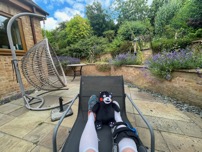
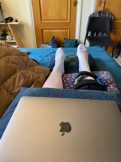
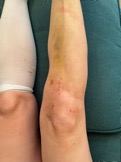
Escape to the garden (with Kumamon), ready for a meeting, a Starbucks lunch, and Nigel getting better (but somewhat skinny).
Useful reading material
The aforementioned book: Rebound: train your mind to bounce back stronger from sports injuries
I’ve been reading Jill Homer’s blog/substack for many years, and she had a very similar injury (albeit with much worse initial consequences) earlier this year. Also Sophie Speidel on Substack and Alyssa Godesky on Instagram.
Useful things
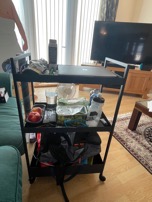
IKEA trolley: the most valuable player, allowed me to keep the essentials of everyday life easily to hand.
Waterproof full-leg cast cover: kept the wound and brace dry while showering.
Cheap Amazon crutches: let me practice hopping around and in and out of the house, and also work out the logistics of going to the loo pre-surgery. Post-surgery, they were useful as a 2nd upstairs pair of crutches.
IKEA plastic chair: multiple uses: butt-shuffling into the bath for washing, resting my leg on when doing weights, sitting on to talk to our guinea pigs…
Table top ice making machine: much easier than crutching to the freezer every 2 hours for ice.
360-degree swivel shower chair (actually used it with an over-bath shower attachment).
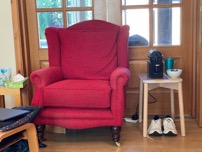
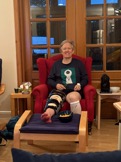
Charity shop ‘fireside’ chair: I thought I’d spend a lot of time sitting in this with my leg on a footstool, but lying on the sofa was more comfy. It was useful for drinking espresso, though.
Overbed table with wheels: didn’t use this as much as I anticipated, but it was useful for occasionally writing and drawing up sewing patterns.
Cycling gloves: to avoid my hands getting sore on trips out.